











Nogales Decaf
ColombiaFarm: Nogales
Region: Bruselas, Huila
Altitude: 1600 – 2000 masl
Region: Typica
Processing: Decaf, Mosto
Flavor notes: mandarin, panela, banana
Cupping score: 88
Best for: Filter
AciditaMedium
IN STOCK
Dispatched on the day of roasting
ALWAYS FRESH COFFEE
Roasted Mon, Tue & Thu
FREE SHIPPING
Depending on location

coffee
needs time
You can drink this coffee as soon as it arrives. However, we recommend waiting a while until it reaches its peak quality and brewing it using a filter no sooner than 10 days after roasting.
For this coffee, the optimal date is
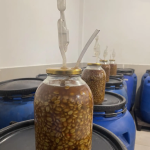
After half a year, this gem from farmer Oscar Hernandez is back in our lineup. His previous decaf sold out very quickly, so we’ve prepared ourselves and ordered double the amount this time. If you’re thinking this isn’t for you, you’re definitely mistaken. With this coffee, you wouldn’t know it’s decaf. Like Oscar’s other lots, this one is processed using the mosto method – that is, fermentation using coffee cherry juice. This gives the coffee a lovely fruity flavour and makes it very sweet.
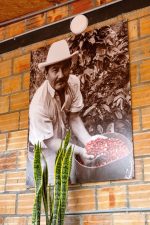
Los Nogales Farm is a family business, so it is difficult to talk about just one name. But for us, the charismatic Oscar Hernandez, the leader of the project, represents the farm. Oscar is a third generation farmer who grows coffee in the south of the department of Huila, near the town of Bruselas. He is an energetic, always positive and innovative person, not only for his family but also for the wider environment. His father, Ricaurte Hernandez, was the first to prove what we already know today, that in Bruselas you can find the best coffees from all over Colombia. In 2006 he won the Colombian Cup of Excellence and, as the locals say, he got the word out. Ricaurte has “put” Bruselas, and with it the entire department of Huila, on the map of fine coffee. Oscar continues this tradition, and thanks to him and his approach, Los Nogales is a center of innovation and information for all the proactive farmers in the area.
The three pillars of the Finca Los Nogales approach:
1. Terroir – the land gives us life and gives it to the coffee plants that grow on it. Los Nogales is aware of this. If we just exploit the land and don’t take care of it, we will soon have no place to grow coffee. In contrast to intensive farming and the conventional approach to fertilization, the entire Los Nogales team is thinking about long-term sustainability. They are replacing commercial intensive single-component fertilizers with complex organic humus processed from their own coffee processing residues. They are also gradually planting the coffee plants further apart on the plantations, reducing the demands on the land. While less intensive, but also less concentrated and more complex cultivation yields less in the short term, it ensures that in the long term the same land can be used to grow coffee for generations to come.
Together with Bourbon, Typica is genetically one of the most important and original varieties originating from south-western Ethiopia. Sometime in the 15th or 16th century, it was transported to Yemen along with Bourbon. Unlike Bourbon, which did not leave the island of Bourbon (Réunion) until the mid-19th century, Typica’s journey was more arduous. At the end of the 17th century and throughout the 18th century, it moved from Yemen to India, then to Java and finally to the Netherlands, from where it was spread to Central America. Typica is a tall plant characterised by very low yields, susceptibility to disease and good cup quality. Due to these factors, it was gradually replaced in most American countries. It is still widely grown in Peru, the Dominican Republic and Jamaica, where it is known as Jamaica Blue Mountain.

- Selective harvesting & flotation: Ripe coffee cherries are carefully selected and picked, then submerged in water to separate out the defective or unripe ones.
- Fermentation & washing: The cherries undergo fermentation for 24 hours and are then thoroughly washed.
- Drying & hulling: The beans are sun-dried on traditional raised beds and then hulled to remove the parchment layer. Only the resulting green coffee is used.
- Hot water immersion: The green beans are immersed in hot water at 40 °C for 4 hours. This step is repeated in two consecutive cycles.
- Addition of natural solvent: A natural solvent (must), derived from the coffee pulp or husk, is added and the beans are left to soak for 24 hours.
- Coffee washing: After immersion, the beans are carefully washed to remove any remaining residues.
- Drying: The washed coffee is placed in the drying area for approximately 5 days.